
Contents
Key Statistics of the Digital Business Cards MarketDigital Business Card Market by CountryWho is Using Digital Business CardsTop Digital Business Card Statistics You Should KnowROI Statistics of Digital Business CardsBenefits of Using Digital Business CardsBONUS: Traditional Business Cards StatisticsHow to Create a Digital Business CardConclusionFAQDigital Business Card Statistics 2026: Market Size & Trends
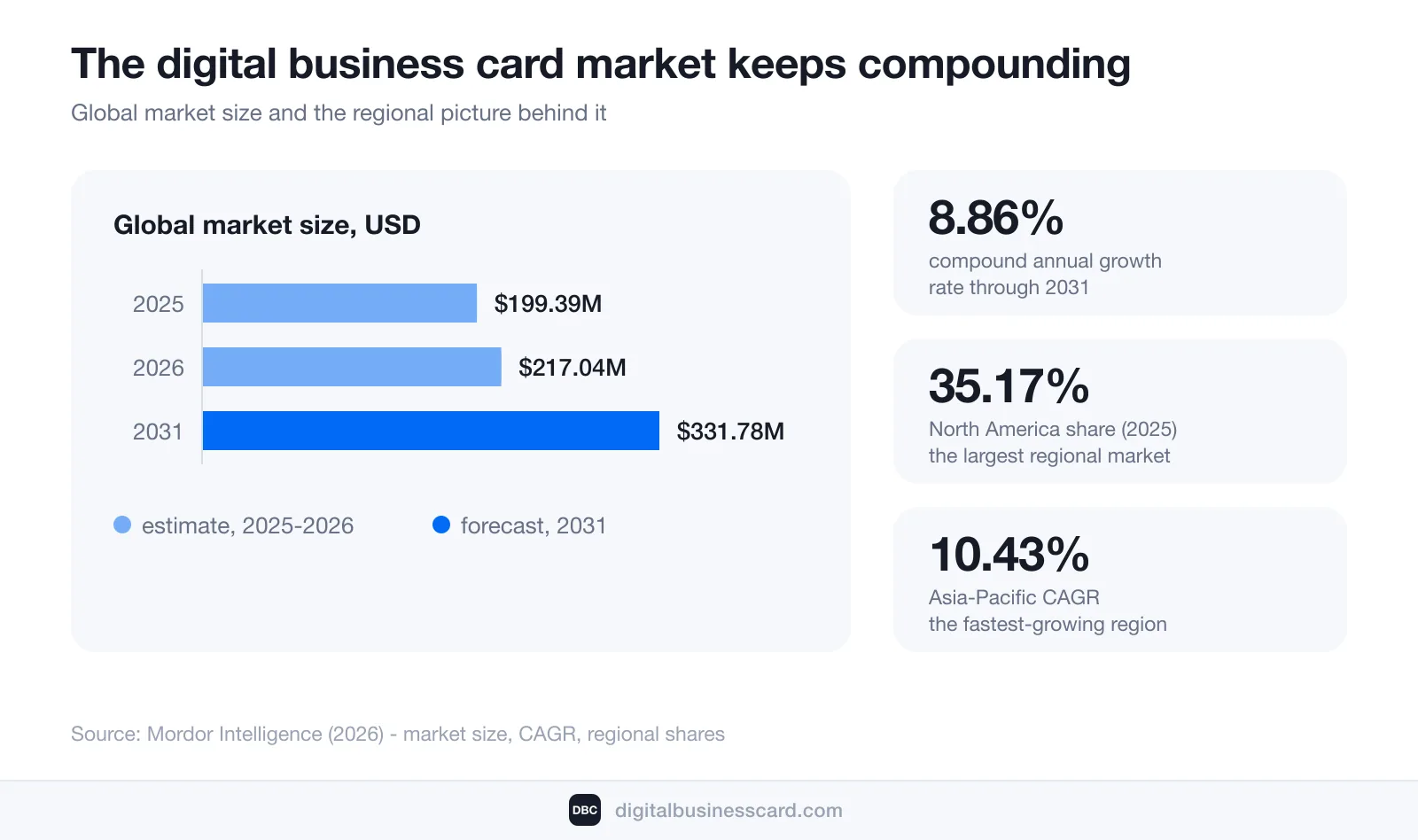
The global digital business card market is worth US$217.04 million in 2026 and is on track to reach US$331.78 million by 2031 — an 8.86% compound annual growth rate, according to Mordor Intelligence. Behind the market curve, adoption keeps climbing: 37% of small businesses and 23% of individuals have already used a digital business card app, and 72% of professionals say they prefer digital cards over paper.
This page collects the digital business card statistics we could verify against a live source in 2026 — market size and forecasts, country-level breakdowns, adoption and usage, ROI, and what is happening to paper cards. Every number below links to the research it comes from, so you can check each claim yourself.
The four headline numbers for 2026:- Market size: US$217.04 million in 2026, projected to reach US$331.78 million by 2031 at an 8.86% CAGR (Mordor Intelligence).
- Adoption: 37% of small businesses and 23% of individuals have used a digital business card app (Maximize Market Research).
- Preference: 72% of professionals prefer digital business cards over paper (Business Research Insights).
- Paper waste: 88% of paper business cards are thrown away within a week of being handed out (Adobe).
If you are new to the format, start with our explainer on what a digital business card is — then come back for the numbers that show where the industry is heading.
Key Statistics of the Digital Business Cards Market
1) Mordor Intelligence values the global digital business card market at US$199.39 million in 2025 and US$217.04 million in 2026, projecting growth to US$331.78 million by 2031 at a compound annual growth rate (CAGR) of 8.86%.
2) Analyst forecasts differ on scope but agree on direction: Market Research Future projects US$528.12 million by 2035 (9.48% CAGR), while Business Research Insights models a broader market reaching US$0.92 billion by 2035 (8.6% CAGR) and Maximize Market Research expects US$460.74 million by 2032 (11.9% CAGR). Every major firm forecasts high single-digit to low double-digit annual growth through the early 2030s.
3) North America is the largest regional market. Mordor Intelligence puts its share at 35.17% in 2025; Market Research Future estimates 37.68%.
4) Europe generated about US$56.58 million in digital business card revenue in 2025, per Market Research Future.
5) Asia-Pacific is the fastest-growing region, at a 10.43% CAGR per Mordor Intelligence (Market Research Future models it even higher, at 11.17%).
6) The Middle East and Africa market was worth US$13.07 million in 2025, and South America held a 7.40% global share, per Market Research Future.
7) By operating system, Android holds 70.1% of the market versus 29.2% for iOS (Maximize Market Research, 2025). The fastest-growing platform segment is progressive web apps, at a 9.11% CAGR (Mordor Intelligence). Given that split, the practical starting point for most people is creating a digital business card on Android.
8) Small and medium enterprises are the largest user segment at 38.51% of the market in 2025; academia and non-profits are the fastest-growing segment at a 10.48% CAGR (Mordor Intelligence).
9) Annual subscriptions account for 41.23% of revenue, while freemium plans are the fastest-growing pricing tier at a 10.66% CAGR (Mordor Intelligence).
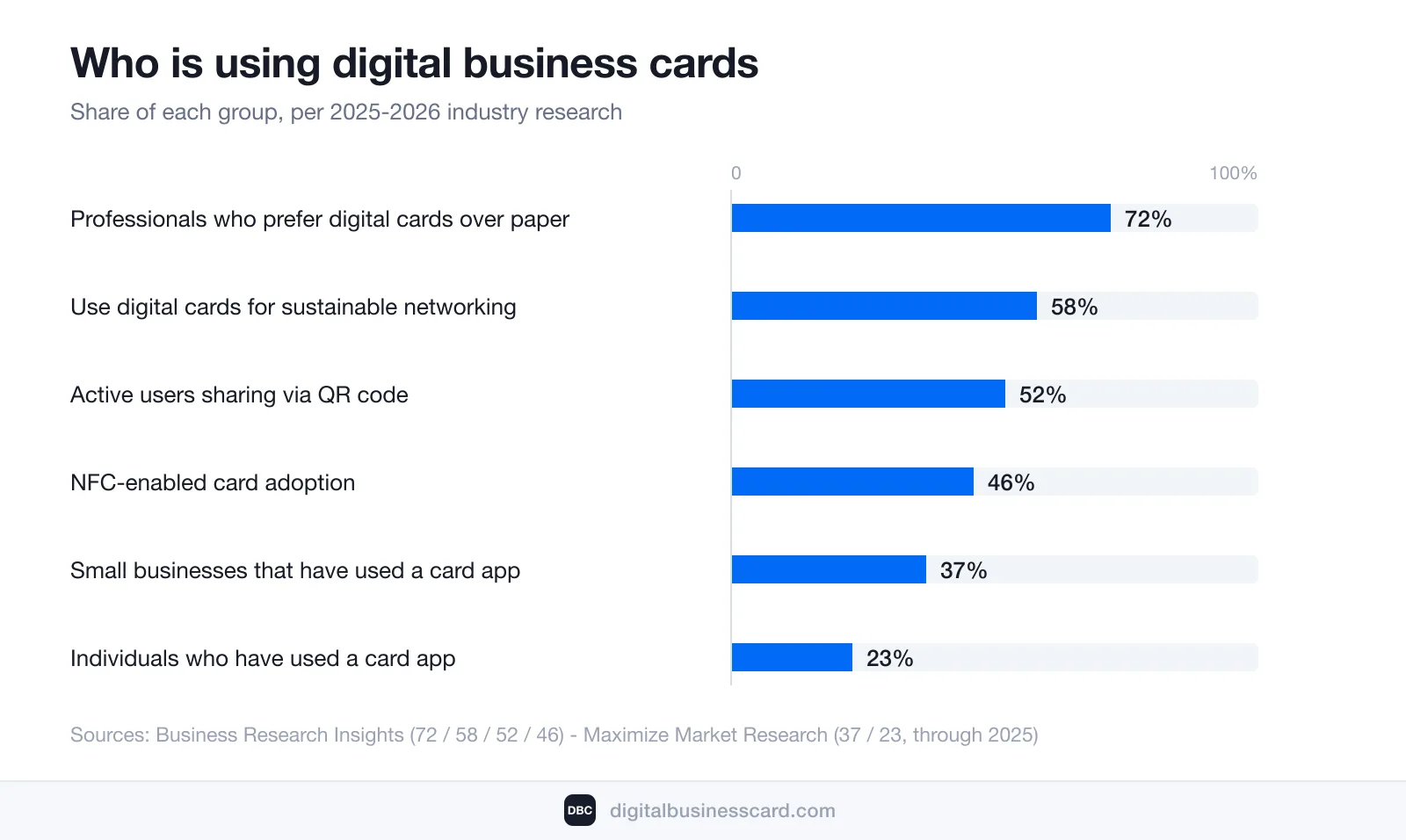
10) By industry, IT and software lead with 29.46% of the market; healthcare is the fastest-growing vertical at a 9.27% CAGR (Mordor Intelligence).
11) DBC: Digital Business Card is used by 100K+ professionals around the world.
Digital Business Card Market by Country
All country-level figures in this section come from Market Research Future's 2025 regional analysis.
12) The United States generates 78.40% of North American digital business card revenue.
13) Canada holds 12.30% of the North American market, supported by steady enterprise and startup adoption.
14) Germany is Europe's largest market with a 22.70% regional share, helped by corporate sustainability mandates and government-backed green-digitalisation programs.
15) The UK market was worth US$11.18 million in 2025 — the only European country broken out in dollar terms.
16) In the GCC, Saudi Arabia leads with 28.10% of Middle East and Africa revenue, and the UAE is the region's fastest-growing country at an 11.42% CAGR. Mordor Intelligence notes GCC smart-city programs are building business-card functionality directly into e-government platforms.
17) In Asia-Pacific, China holds 31.50% of regional revenue, while India is the fastest-growing country at a 12.84% CAGR.
Who is Using Digital Business Cards
18) 37% of small businesses and 23% of individuals have used a digital business card app, per Maximize Market Research (through 2025) — up from a small minority at the start of the decade.
19) 72% of professionals prefer digital cards over paper, and 58% use them specifically for sustainable networking, per Business Research Insights.
20) By sharing technology, 52% of active users rely on QR-code sharing, while NFC-enabled cards have reached 46% adoption (Business Research Insights).
21) Enterprise workflows are catching up: CRM integration surged to 42% of deployments, and cloud-based sharing platforms reached 36% adoption (Business Research Insights).
22) The remaining barriers are trust and portability: 41% of users cite data-security concerns and 33% cite limited interoperability across platforms (Business Research Insights).
23) The addressable audience keeps expanding: 4.3 billion people (~54% of the world) own a smartphone (Business Research Insights), and 85% of Americans have one.
Wondering which apps those users actually pick? See our tested ranking of the best digital business cards.
Top Digital Business Card Statistics You Should Know
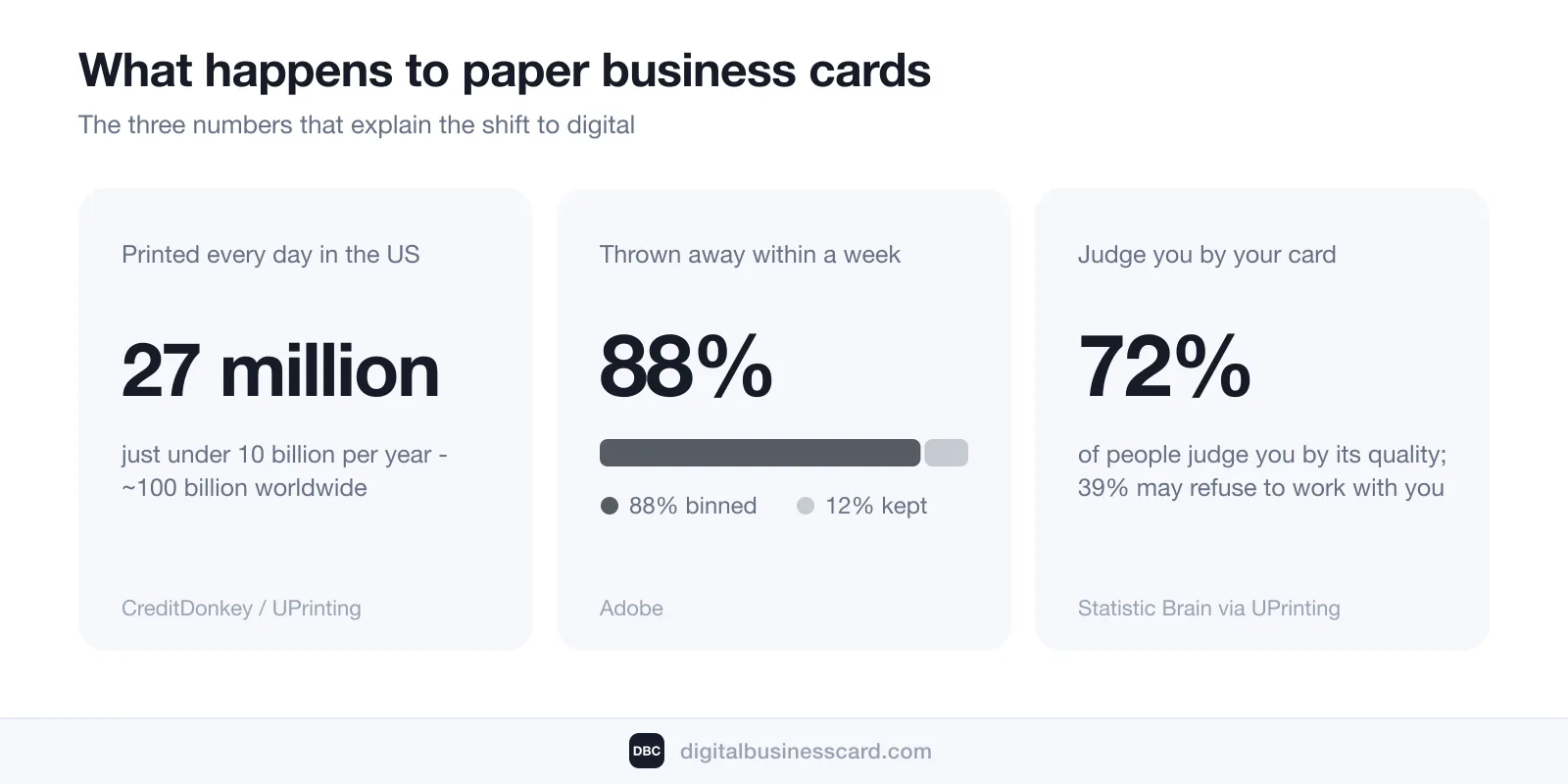
24) 27 million paper business cards are printed every day in the US — just under 10 billion per year. Worldwide, the total approaches 100 billion cards annually.
25) 88% of paper business cards are thrown away within a week — roughly 8 billion cards a year in the US alone (CreditDonkey; Adobe).
26) 63% of recipients discard a card simply because they don't need the service at that moment (Adobe) — the contact is lost before the need ever arises, which is exactly the failure digital cards fix by living in the recipient's phone.
27) Design still decides deals: 72% of people judge a company or person by the quality of their business card, and 39% may refuse to work with someone whose card looks poorly made, per a Statistic Brain survey cited by UPrinting.
28) The US business card printing market generates approximately $800 million per year, but print volume has declined by over 70% since the pandemic.
29) Cards that carry QR codes or NFC achieve about 30% more engagement than plain printed formats (UPrinting).
30) A colored card lasts roughly 10x longer in a recipient's hands than a standard white card (Adobe) — design quality directly buys retention time.
31) The waste is measurable: around 12,000 tonnes of business cards are discarded every year, 54% of customers prefer cards made from recycled materials (printtobrand), and recycled-material cards are retained 25% longer (UPrinting).
ROI Statistics of Digital Business Cards
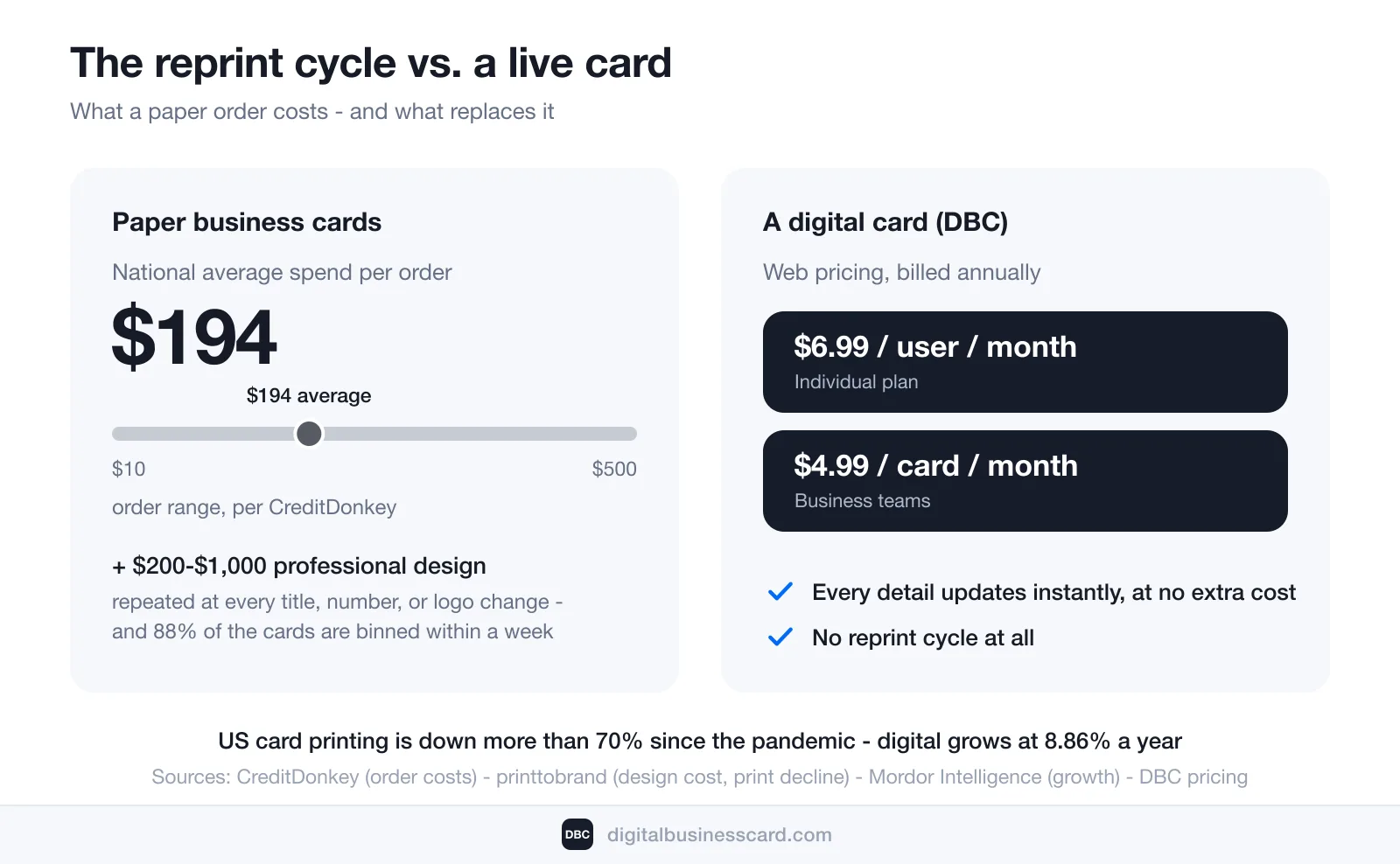
32) A paper business card order costs anywhere from $10 to $500, and the national average spend is $194 per order (CreditDonkey). Since 88% of those cards are discarded within a week, most of that budget goes straight into the bin.
33) Professional card design adds $200 to $1,000 on top of printing (printtobrand), with graphic designers charging $25–$150 per hour (CreditDonkey) — and the whole investment is repeated every time a title, number, or logo changes.
34) A digital card removes the reprint cycle entirely. DBC's web pricing is $6.99 per user/month (billed annually) for individuals and $4.99 per card/month (billed annually) for business teams — and every detail on the card can be updated instantly, at no extra cost, for every contact who already has it.
35) The spend is visibly shifting: US card-printing volume is down more than 70% since the pandemic (printtobrand) while the digital business card market grows at 8.86% a year (Mordor Intelligence).
Benefits of Using Digital Business Cards
If you are unsure whether you need digital business cards, here are the most significant benefits of using them.
1. Cost SavingsPrinting and reprinting paper cards can add up quickly, including design, shipping, and updates. A digital business card is a setup that can be updated instantly at no extra cost, saving businesses and individuals significant annual expenses.
2. Always Up to DateUnlike paper cards that become useless if a phone number or title changes, digital business cards can be edited in real time. This ensures every new contact always has your correct details without reprinting costs.
3. You are Saving NatureTraditional cards contribute to paper waste, with billions thrown away every year. Digital cards help reduce your carbon footprint and align your business with sustainable practices.
4. Enhanced BrandingDigital cards aren't limited to paper design — they can include custom colors, logos, photos, links, and even videos. This gives professionals the opportunity to stand out and make a stronger impression.
5. Easy Sharing Across ChannelsYou can share a digital card via QR code, NFC tap, email signature, or even text message. This flexibility makes networking smoother, especially at large events or online meetings.
6. Integrated AnalyticsMany digital card platforms provide analytics such as views, clicks, or saves. These insights help you understand how often your card is used and which links drive the most engagement.
7. Better Contact RetentionPaper cards are often misplaced or discarded, but digital business cards literally live in a recipient's phone or email. This improves the chance that your contact information will be saved and used.
8. CRM and Workflow IntegrationDigital business cards can sync with tools like HubSpot, Salesforce, or Google Contacts. This automates lead capture and ensures new contacts flow directly into your existing systems.
BONUS: Traditional Business Cards Statistics
36) The global print market for business cards is still worth approximately $7 billion, with demand persisting despite digital alternatives.
37) Business cards have been used for over 300 years (originating in 17th-century Europe), carrying a sense of etiquette and professionalism that digital cannot fully replicate.
38) According to Adobe, sales increase by 2.5% for every 2,000 printed business cards distributed.
39) The standard business card measures 3.5" x 2" in the US — a format that has barely changed in a century, while its digital successor fits any screen.
40) Older generations (50+) are generally more likely to keep paper cards than digital contacts, seeing them as more reliable.
41) Despite environmental worries, paper cards have a traditional tactile feel and physical presence that many professionals cherish for their impression and personalization possibilities.
42) Modern paper cards incorporate textures, metallic foils, and unique shapes to stand out; such design innovations keep physical cards relevant for premium brands.
How to Create a Digital Business Card
1. Go to the DBC: Digital Business Card appStart by visiting the original DBC: Digital Business Card platform.
2. Click "Get Started"You'll find the button in the upper-right corner of the homepage.
3. Download the appScan the QR code to install the app on your iOS or Android device.
4. Open the app and choose a templatePick from 27+ professional design templates to get started.
5. Add your detailsEnter your name, company, job title, photo, and links to websites or social profiles.
6. Finalize your card
Add your email address, save the card, and you're ready to go. You can now share it instantly via QR code or a simple link. For the full walkthrough — prep checklist, platform criteria, and distribution setup — see our guide on how to make a digital business card.
Conclusion
The numbers make one thing clear: paper is fading and digital is compounding. A market growing at 8.86% a year, print volume down 70% since the pandemic, 88% of paper cards binned within a week, and 72% of professionals already preferring digital — the direction is not in question, only the pace.
By reviewing the latest Digital Business Card Statistics, professionals and businesses can see not just a trend but a fundamental shift in how connections are made and maintained. Every figure on this page traces to a live source, so when you cite it — in a deck, an article, or a budget discussion — the number will hold up.
Whether you're running a startup, leading a global team, or simply looking to modernize your personal brand, the move to digital isn't a question of if — it's a question of when.
FAQ
How big is the digital business card market in 2026?
What trends show that digital business cards are becoming more popular?
Do digital business cards actually perform better than paper?
Are companies saving money by switching to digital business cards?

A content writer with over 8 years of experience creating analytical content for digital products and B2B SaaS companies. His work focuses on practical guides, pricing breakdowns, and comparisons that help teams evaluate costs, features, and differences between tools.
Your first impression decides everything
- Look professional and build trust instantly
- Forget about reprints and lost contacts
- Update your details anytime
 Get Started Today